
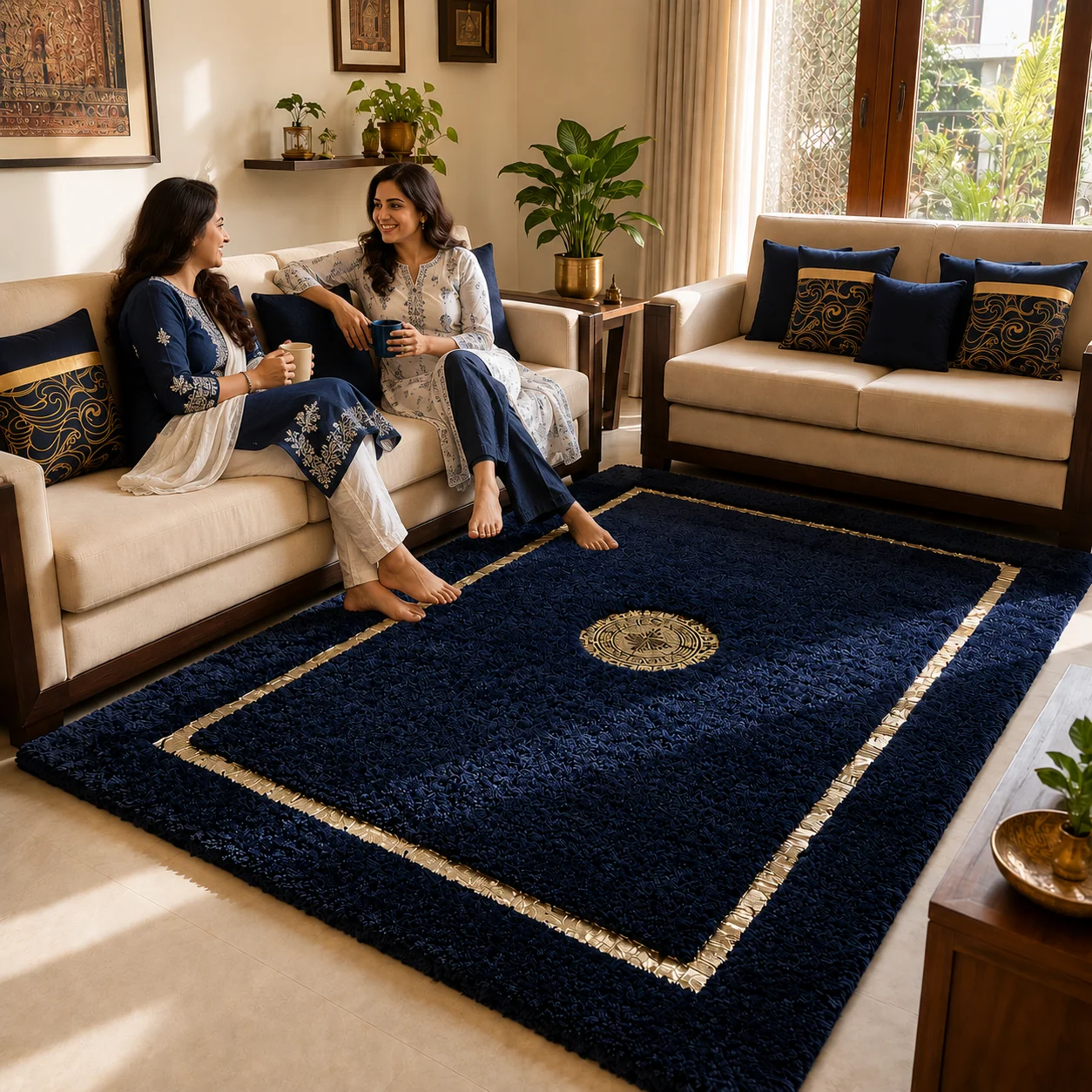

Walk into a living room that feels subtly off-balance despite great furniture and fresh paint, and your eyes will almost always land on a tiny rug stranded in the center of the floor. Often referred to by interior designers as a postage-stamp rug, an undersized area rug shrinks the visual footprint of a room, disconnects seating pieces from one another, and leaves sofas looking like they are drifting out toward the walls.
Buying a rug that is one or two sizes too small is easily the single most common decorating mistake homeowners make. Large rugs carry higher price tags, and standard 5-by-8-foot sizes look deceptively generous folded on a store display or viewed in a product thumbnail. Once unrolled beneath an 84-inch sofa, a pair of accent chairs, and a coffee table, that same rug suddenly looks like a bath mat. Fortunately, a straightforward interior design guideline—the front-legs-on rule—takes the guesswork out of rug sizing and anchors your entire seating arrangement immediately.
Why Undersized Rugs Throw Off an Entire Room
An area rug has one primary architectural job in a living room: defining the conversation zone. Without architectural walls separating a seating area from walkways or an adjacent dining space, the rug acts as the visual boundary that tells your eye where the gathering space begins and ends.
When a rug sits completely in front of the sofa with only a coffee table resting on top—often called the floating island layout—several visual problems happen at once:
-
Fragmented sightlines: Instead of reading the sofa, chairs, and coffee table as one cohesive grouping, the eye sees isolated pieces scattered across bare hardwood or tile.
-
Shrunken room proportions: A small rectangle in the middle of the floor draws attention inward and highlights all the empty flooring around it, making a spacious living room feel narrower than it actually is.
-
Awkward seating ergonomics: Anyone sitting on the sofa ends up with their heels resting half on the rug and half on the bare floor, while accent chairs sit completely off the edge.
-
Wobbly coffee tables: If a rug is narrow enough that two legs of the coffee table sit on the pile and two sit on hardwood, every mug or glass placed on top wobbles slightly.
How the Front-Legs-On Rule Works
The front-legs-on rule strikes the ideal balance between visual cohesion, practical furniture stability, and budget. Under this guideline, your rug should be large enough that at least the front two legs of your main sofa and all accent chairs rest comfortably on top of the rug, while the back legs stay on the bare flooring behind them.
By tucking the front edge of your seating onto the rug—ideally by 8 to 12 inches rather than barely grazing the fringe—you physically link every seat to the central coffee table. The rug bridges the gap beneath your feet, eliminates trip edges right in front of the sofa cushions, and frames the conversation zone as a unified island.
Just as important, pay attention to side overhang. A rug should extend at least 6 to 12 inches past the left and right arms of your sofa on both ends. If a rug is wide enough for the front legs to sit on top, yet stops flush with the outer armrests of the couch, the proportions still feel cramped and pinched.
When to Go Even Bigger: The All-Legs-On Layout
While the front-legs-on rule works brilliantly for most standard living rooms—especially when a sofa sits against a perimeter wall—open-concept floor plans often benefit from stepping up to the all-legs-on layout.
When a sofa floats in the middle of a large great room with its back exposed to a kitchen, entryway, or hallway, leaving the back legs off the rug can expose raw furniture framing and make the rear edge look unfinished. Placing all four legs of the sofa, armchairs, and side tables completely on the rug creates a crisp, polished border from every angle. For an all-legs-on arrangement, plan for roughly 12 to 18 inches of visible rug extending behind the sofa and beside the chairs so the furniture sits squarely inside the frame rather than teetering on the outer binding.
Standard Rug Sizes and What Actually Fits
Shopping by room name rather than tape measure measurements is why so many people bring home the wrong dimensions. Matching standard rug sizes to typical sofa widths reveals why common starter sizes fall short in most American living rooms.
5-by-8-Foot Rugs
A 5-by-8-foot rug is almost always too small for a standard living room. Because most full-size sofas measure between 78 and 90 inches (6.5 to 7.5 feet) wide, an 8-foot-long rug leaves almost zero overhang past the armrests once the front legs are placed on top, and its 5-foot depth rarely reaches far enough across the room to catch opposite accent chairs. Reserve 5-by-8 rugs for compact studio apartments, small reading nooks, or layering over a larger natural-fiber jute base rug.
8-by-10-Foot Rugs
An 8-by-10-foot rug is the true starting point for most medium-sized living rooms. Placed horizontally so the 10-foot edge runs parallel to the main sofa, an 8-by-10 rug provides comfortable side overhang past an 84-inch couch while extending 8 feet deep into the room—plenty of span to hold a coffee table and tuck the front legs of two opposing accent chairs onto the opposite edge.
9-by-12-Foot and 10-by-14-Foot Rugs
In spacious family rooms, sectionals, or open-concept living areas, stepping up to a 9-by-12-foot or 10-by-14-foot rug transforms the sense of scale immediately. L-shaped and U-shaped sectionals need generous width and depth so both the main sofa run and the chaise or return section sit anchored on the same surface without cutting diagonally across a corner.
Don’t Forget the Bare-Floor Border Around the Room
Even when following the front-legs-on rule, a rug should never run wall-to-wall like installed broadloom carpet. Leaving a consistent border of exposed hardwood, tile, or luxury vinyl around the perimeter lets the flooring breathe and prevents the rug from swallowing the room.
In most living rooms, aim to leave 12 to 24 inches of bare floor between the outer edges of the rug and the walls or built-in cabinetry. In tighter rooms, an 8-to-12-inch border still frames the space cleanly without making the rug look wedged into corners. Also check nearby door swings and floor HVAC registers before finalizing dimensions so thick pile does not snag entry doors or block warm air vents.
How to Test Your Rug Size Before You Buy
Never trust eyeballing alone when choosing between two rug sizes. Before clicking purchase or hauling a heavy roll home from a showroom, use blue painter’s tape to outline the exact outer dimensions of the rug directly on your living room floor around your existing furniture.
Step back and inspect the taped rectangle from the room’s main entryway as well as from your usual seat on the sofa. Check that the front legs of every seating piece sit comfortably inside the tape lines with several inches to spare, that both ends of the sofa have balanced overhang on either side, and that a clean border of bare flooring frames the outside perimeter. If you are debating between two sizes and both leave reasonable floor clearance around the walls, choose the larger size—a slightly generous rug makes a living room feel intentional and expansive, while an undersized one always looks like a compromise.

Comments are closed.